


Who Designs the Process? The Better Question for Catheter Developers
"Have you built a catheter for my clinical use case before?"
It's the first question on most calls with a contract manufacturer, and it's a fair one. It's shorthand for the thing you actually care about: can you make my device, on time, to spec.
The catch is that it's shorthand. Anatomy experience is a proxy for capability, and a loose one. A shop that's built forty devices in your anatomy but can't design a fixture will still miss your dates. A shop that's never touched your anatomy but owns process design, tooling, and test-method development will hit your spec repeatedly.
So the anatomy question is worth asking. It just isn't the one that separates those two shops. That question is narrower, and harder to fake: who designs the process, and can I talk to them?
What actually transfers between catheter development specialties

Catheter programs at ReCurve right now span all kinds of clinical indications, including many of the hottest areas for innovation. What they have in common is that no two designs are the same. Different anatomy, different access, different delivery requirements, different regulatory context, different therapeutic goals, and those are only part of what varies from one program to the next.
What does not change:
Shaft construction. Coiled and braided shafts behave according to physics, not according to which vessel they end up in. Pitch, wire, durometer transitions, and how a stiffness change is managed along the length are the same engineering problem in a sinus device and a structural heart device.
Bond and joint integrity. Every joint on a catheter is a place it can fail. The materials science of joining dissimilar polymers, and proving that joint holds, is portable across every specialty.
Cleanroom material discipline. Which materials can enter a controlled environment, and which cannot, does not depend on the target anatomy.
Balloon and catheter interaction. A balloon has to meet the customer spec and survive the catheter process. That constraint is identical whether the balloon is 2mm or 30mm.
Process capability. Whether a build is repeatable at volume is a manufacturing engineering question. Anatomy is an input to it, not a substitute for it.
What is genuinely specialty-specific is smaller than most buyers assume: the anatomical path, the delivery requirement, the clinical context that drives the spec. Real, and worth respecting. But that knowledge lives with the customer, who has spent years on it, and it gets transferred in the first two conversations.
Where specialty experience does matter
This is not an argument that experience is irrelevant. It is an argument about which experience.
Depth in process design compounds across every program a shop touches. Depth in one anatomy does not. We have taken more than 70 commercial programs through validation across neurovascular, cardiovascular, gastrointestinal, urological, and peripheral applications. Every one of those left behind a solved problem, a test method, or a fixture design that the next program can draw on. A team with that library has more to bring to your device than a team that has run the same coronary build forty times.
At ReCurve, the anatomical knowledge is in house as well. Customers regularly get design advice on the access path and the clinical conditions their device has to handle, because someone on the team knows that ground. The point is that it arrives on top of the process capability, not instead of it.
The practical version
If you are evaluating a catheter contract manufacturer, replace the specialty question with these:
Who designs the tooling and the fixtures, you or us?
If we need a test method that does not exist, will you build it?
Can I talk directly to the engineer who will own my process?
What happens to my program when it moves from development to commercial volume?
How fast do I get an answer when something goes wrong on a Friday?
Those five answers will tell you more about whether your program lands than any specialty list.
A catheter is a catheter. Hold the spec, design the process, control the build. The anatomy is a requirement, and requirements are what engineering is for.
The ReCurve Approach
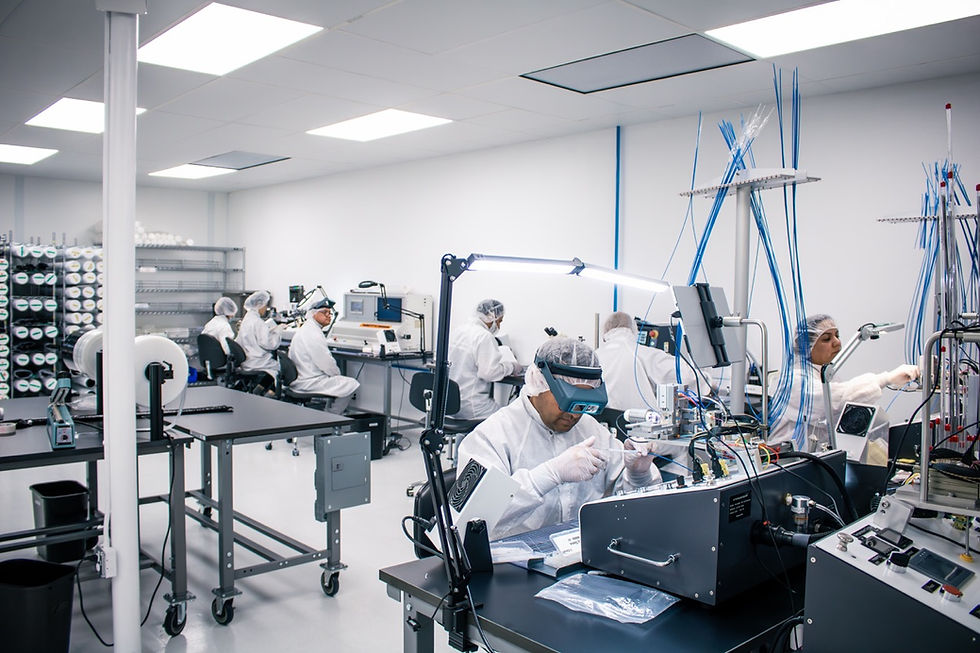
One team, one quality system, one cleanroom. More than 70 commercial programs through validation, across multiple clinical areas. Balloon forming, full catheter development, tooling and fixture design, and test method development happen under one roof and one set of engineers, from early development through commercial volumes. Have a program that needs its process designed, not just built? Talk to our engineering team.



Comments